
Choosing and learning a framework
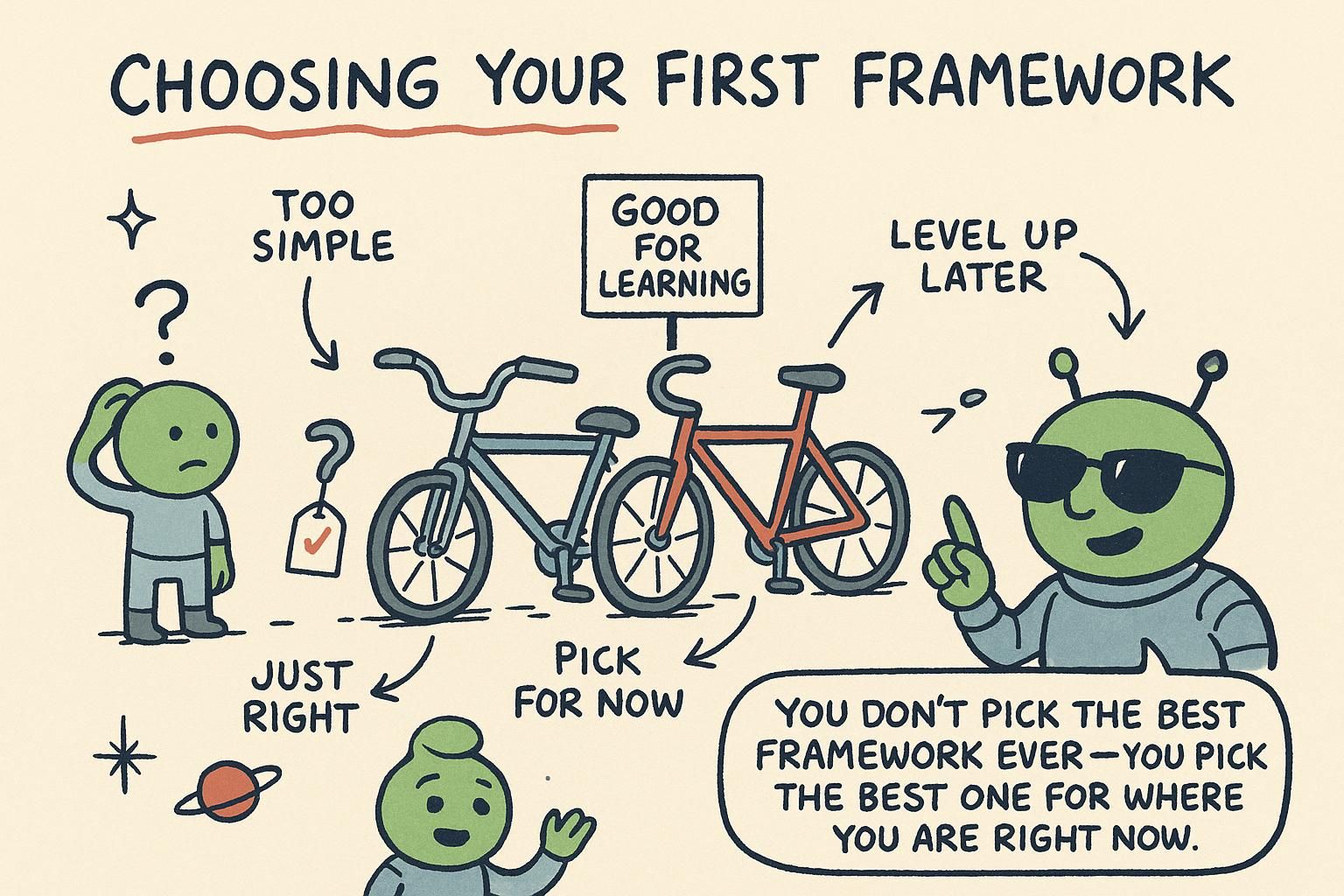
The last two chapters covered what frameworks are and what exists. This one is the practical end: whether to use one, which one, and how to learn it. The order matters, because the first question is the one that gets skipped most often.
Should you use a framework at all?
Picture two projects. The first is an app with accounts, forms, and screens that all react to shared data. Hand-rolling that means rebuilding exactly the plumbing a framework has already perfected, and the vanilla version ends up as a scattered, half-tested framework of your own invention that nobody wants to inherit. Reaching for Django or React there is choosing fewer moving parts than the alternative.
The second is a landing page, a content site, a small script, a form that submits somewhere. Plain HTML, CSS, and a little JavaScript cover these with no build step, no dependency updates, and nothing to migrate next year. Wrapping a page like that in a full framework adds machinery that only the tooling benefits from. Plenty of experienced developers ship vanilla on purpose, and it is a professional answer, never a beginner's compromise.
Engineering has a blunt old rule that covers both cases: KISS, "keep it simple, stupid". The insult is aimed at the design rather than the designer, and the idea is that the best solution is the one with the least machinery that still does the job. Both projects above obey it, and they land on opposite answers.
That makes the test one question, asked fresh for each project: choose whichever option leaves you less machinery to maintain. When the plumbing dwarfs the product, that is the framework. When the product is nearly all there is, that is vanilla.

How to choose one
When the answer is yes, choose with unglamorous criteria. Benchmarks and feature comparisons are the least useful inputs, because within a family the popular options are all fast enough and all capable enough. What actually shapes your daily life:
The ecosystem and community: mature documentation, answered questions, and packages for the problems you will hit. The team and codebase you are joining: the best framework is usually the one your project already uses, and consistency beats novelty inside a team. The job market, if learning for work: sheer usage numbers matter, which is a large part of why React is many people's rational first pick. And the language you know: a Python developer reaches Django faster than Rails for reasons that have nothing to do with quality.
Keep the vanilla option on the list to the end. If the comparison table fills up and none of the candidates beats "none of the above" on the simplicity test, that is the answer telling you something.
How to learn any framework
Learn the language first. A framework assumes its language everywhere: React code is JavaScript wall to wall, and every confusing line of a Django app is Python underneath. Learners who skip to the framework end up debugging two mysteries at once, the framework's behaviour and the language's syntax, with no way to tell which is which. If React is your goal, the JavaScript track is the actual first step; for Django or pytest, the Python track plays the same role. Language first is the single biggest shortcut there is, because it is the part that transfers everywhere.
Then build something small and real. One little project you actually want, built while leaning on the official tutorial, teaches more than any amount of watching and reading, because the framework's shape only makes sense under your own hands. Keep the first project modest on purpose: its whole job is to introduce you to the framework's ideas, and the masterpiece can come later.
And as you go, keep asking what the framework is doing for you. Every convenient feature is standing in for something real: a route stands in for URL parsing, a component for DOM updates, a model for SQL. You do not need to master those layers upfront, but knowing they exist, and roughly what the framework does with them, is what separates using a framework from depending on it blindly.
Where this leaves you
That is the whole primer: simplicity as the test, unglamorous criteria for the pick, language before framework for the learning. When a specific framework shows up next, in these docs or in the wild, The kinds of frameworks is the map to place it on, and What is a framework is the definition underneath it.