

The kinds of frameworks
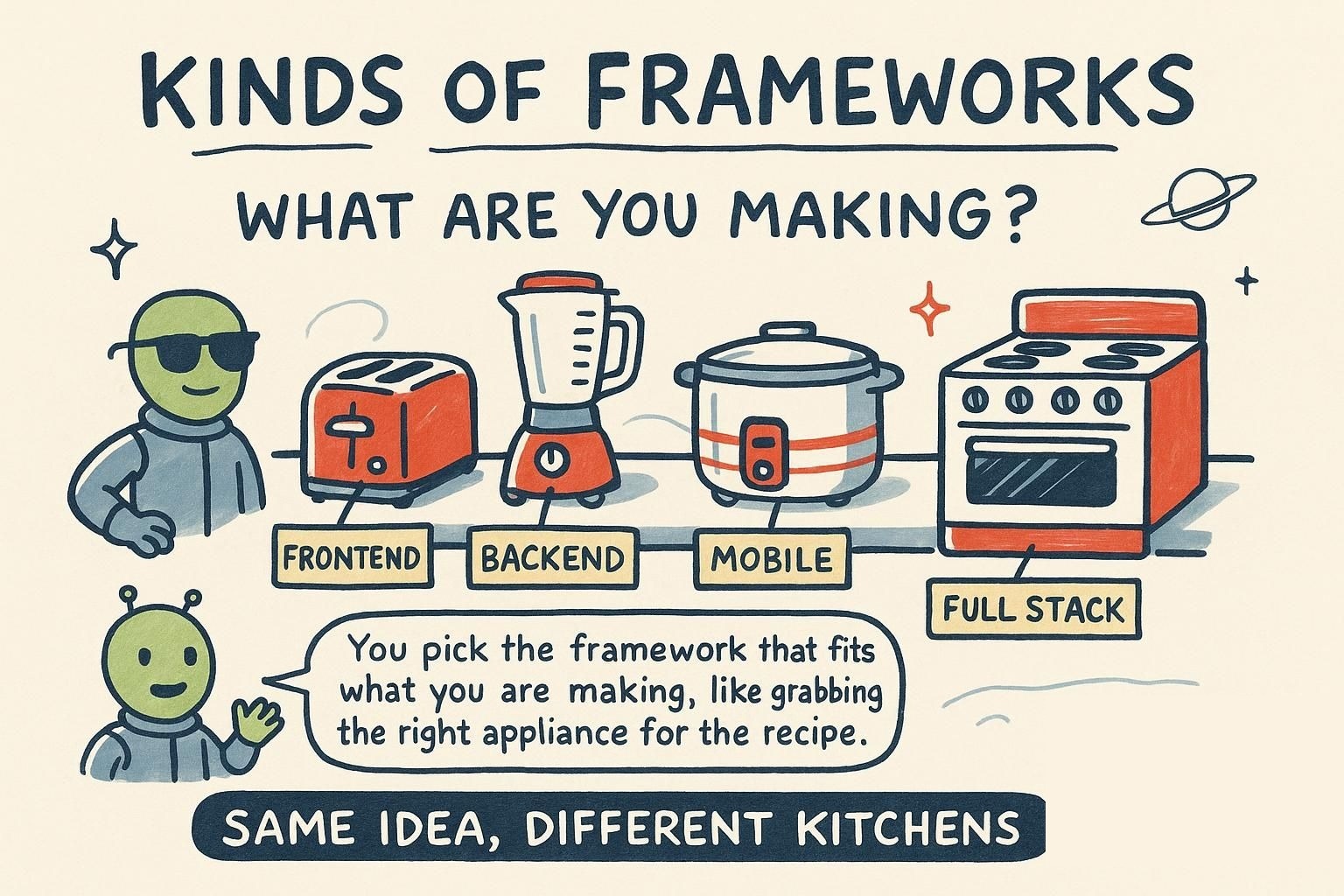
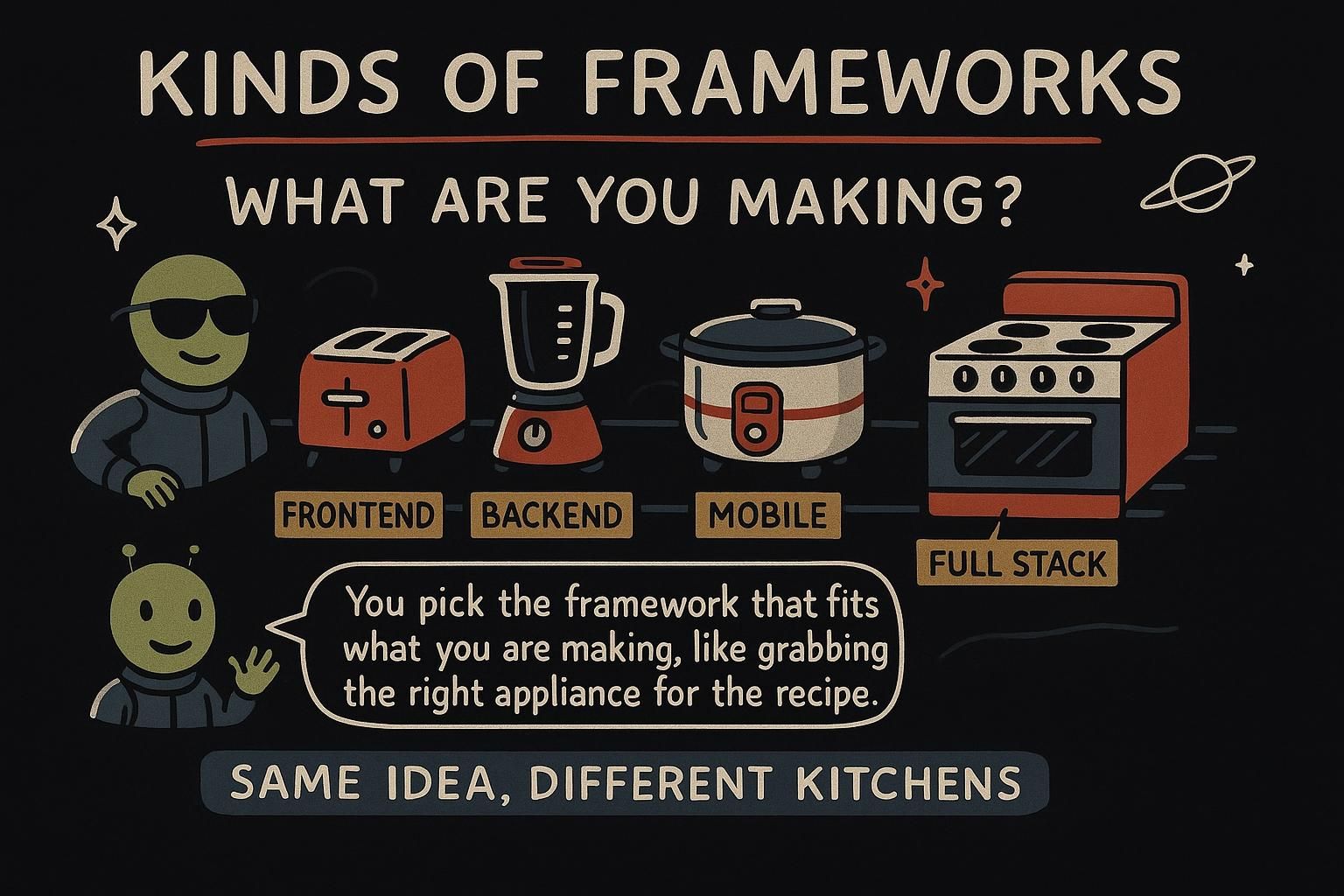
What is a framework covered the idea: structure plus solved plumbing, with the framework calling your code. This chapter is the map of what actually exists: a tour with a reassurance built in, because nobody knows all of these. Working developers know one or two families well and recognise the rest, and that is the goal here too. Families matter more than names: learn one member well and its siblings come quickly.
The web: front-end and back-end
Web frameworks split along the line the web itself splits on. Front-end frameworks run in the browser and manage what the user sees; back-end frameworks run on a server and manage data, accounts, and everything behind the scenes. If you are heading into web development, one from each side will likely become a daily tool, and which one is usually decided by the team or project you join rather than by you.
The front-end names you will meet:
- React: the most used by a wide margin, with the largest ecosystem and job market. Technically a UI library rather than a full framework, a distinction with a useful core covered below.
- Vue: known for a gentle on-ramp and documentation people actually enjoy; a complete, well-organised middle path.
- Angular: Google's batteries-included framework, opinionated about everything; most at home in large organisations that want one sanctioned way to do each thing.
- Svelte: does its work at build time and ships less code to the browser; smaller community, frequently admired by the people in it.
And the back-end names, where the framework is usually tied to a language:
- Django (Python): batteries included, from database to admin interface; a frequent partner to the Python you may already know.
- Rails (Ruby): the framework that popularised convention over configuration; its ideas echo across most modern web frameworks, Laravel included.
- Laravel (PHP): the modern standard of the PHP world, which still runs a very large share of the web.
- Express (JavaScript): deliberately minimal, closer to a toolkit than a full framework; you assemble the rest yourself.
- Spring (Java): the enterprise workhorse; sprawling, deeply established, and everywhere in large companies.
That split is less tidy than it looks, and the reason is common enough to be worth knowing early. React, Vue, and Svelte only handle the interface, so a larger framework grew up around each of them: Next.js for React, Nuxt for Vue, and SvelteKit for Svelte. These are called meta-frameworks, and they add what the base library leaves out: page routing, data loading, and code that runs on a server. That last part is the important one. A Next or Nuxt project contains both the front end and the back end in one codebase, and many teams build a complete application with one of these and no separate back-end framework. Most new React and Vue projects start with the meta-framework rather than the library alone, so you will meet one of these names early.

Apps and games
Mobile development has its own framework story, and it centres on one question: build separately for iPhone and Android, or once for both? Two frameworks dominate the build-once answer. Flutter (from Google, using the Dart language) draws its own interface pixel by pixel, so apps look identical everywhere. React Native brings React's component model to mobile and drives each platform's native interface pieces, which is a natural continuation if you already know React.
Game engines are frameworks at their most total: they own the loop that runs sixty times a second, and your code fills in what each object does within it. Unity (C#) is the default for indie and mid-sized games and much of mobile gaming. Unreal (C++) leads where visual fidelity is the point, from big-budget games to film production. Godot is the free, open-source engine whose community has grown quickly, and a friendly place to start.
The quiet ones: testing and data
Not every framework is about building a product; some organise the work around it. Testing frameworks are the clearest case, and the purest example of the last chapter's definition: pytest (Python), Jest (JavaScript), and JUnit (Java) each find your test functions, run them, and report, with you never writing a program that calls your own tests. You will meet one of these in nearly every professional codebase, usually the one matching the project's language.
Data and machine learning have frameworks too. PyTorch dominates research and increasingly production; TensorFlow is Google's ecosystem with deep production tooling. Both handle the mathematical machinery of training models so that your code describes the model rather than the calculus. If the How AI Works track interested you, these are the tools that world builds with.
Where this goes next
That is the map: web on both sides of the wire, mobile, games, testing, and data, all the same idea wearing different uniforms. The remaining question is the practical one, and it has two halves: which one, and whether one at all. Choosing and learning a framework takes both head on, and if the definitions here felt shaky, What is a framework is a short read back.